
30 September 2026Based on: Why Lapis Lazuli Was Once More Precious Than Gold
Five Things to Know About Lapis Lazuli
Five things to know about lapis lazuli, including its blue colour, use in ancient jewellery and painting, and what to look for when buying it.
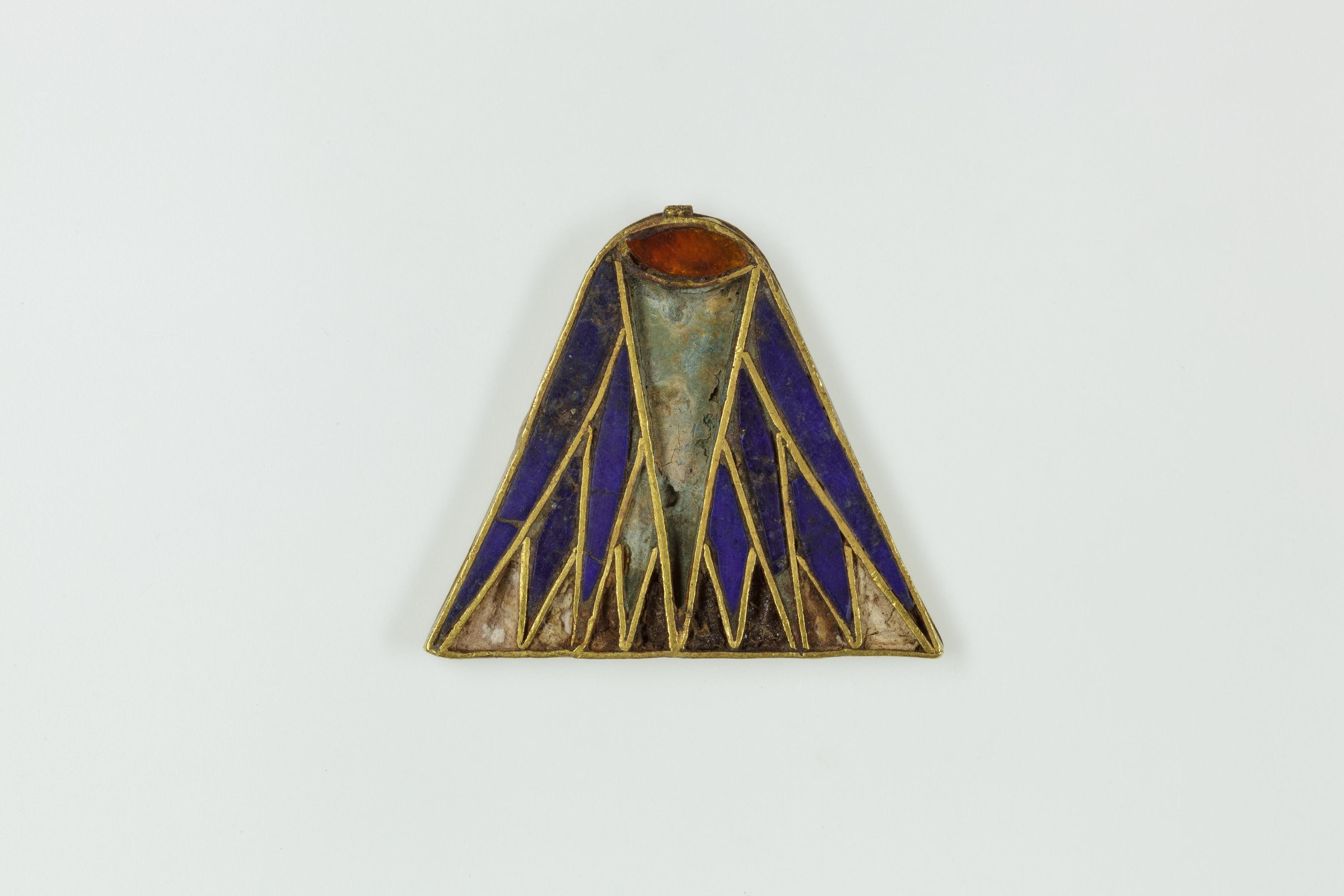
Lapis lazuli has been valued for its rich blue colour for thousands of years. It appears in ancient Egyptian jewellery, carved rings, beads and inlays, and was also used to make ultramarine, the blue pigment found in paintings by artists such as Vermeer.
Its appearance varies from an almost even blue to a mixture of pale streaks and golden flecks. Those differences matter when choosing a piece, as do its design and condition. Here are five things to know about lapis lazuli.
1. Lapis is a rock made up of several minerals
GIA classifies lapis lazuli as a rock because it contains several minerals. The main ones are lazurite, which gives it its blue colour, calcite, which produces white patches or streaks, and pyrite, which accounts for the metallic flecks.
The proportions vary from one piece to another, so lapis can be almost entirely blue or show plenty of calcite and pyrite. The golden flecks are often mistaken for gold, but their colour comes from the pyrite itself.
Lapis is usually opaque and measures 5 to 6 on the Mohs hardness scale, depending on its mineral make-up. Jewellers use it for rounded, polished cabochons, beads and inlays, as well as carved pieces where the shape is as much a part of the design as the colour.
2. The colour matters, but so do the flecks
An even, deep blue with a slight violet tint is generally the most prized colour. Visible white calcite tends to reduce a stone's market value, although a few small, attractively scattered pyrite flecks can be desirable.
Personal taste also comes into it. Some people like a plain blue stone, while others prefer the contrast of pale streaks and metallic flecks. White patches of calcite are part of the stone's natural make-up and should not be mistaken for damage.
If a seller describes a piece as "Afghan blue", ask what they mean. The term can be used as a colour description in the trade, so the name alone does not establish that a stone came from Afghanistan.
3. Lapis was used in ancient royal jewellery
Lapis appears in some of the most elaborate surviving ornaments from the ancient world, including Queen Puabi's headdress from the Royal Cemetery at Ur. Its 20 gold leaves and large gold comb were joined by two strings of lapis and carnelian beads, while further strands of precious metals and stones covered her upper body.
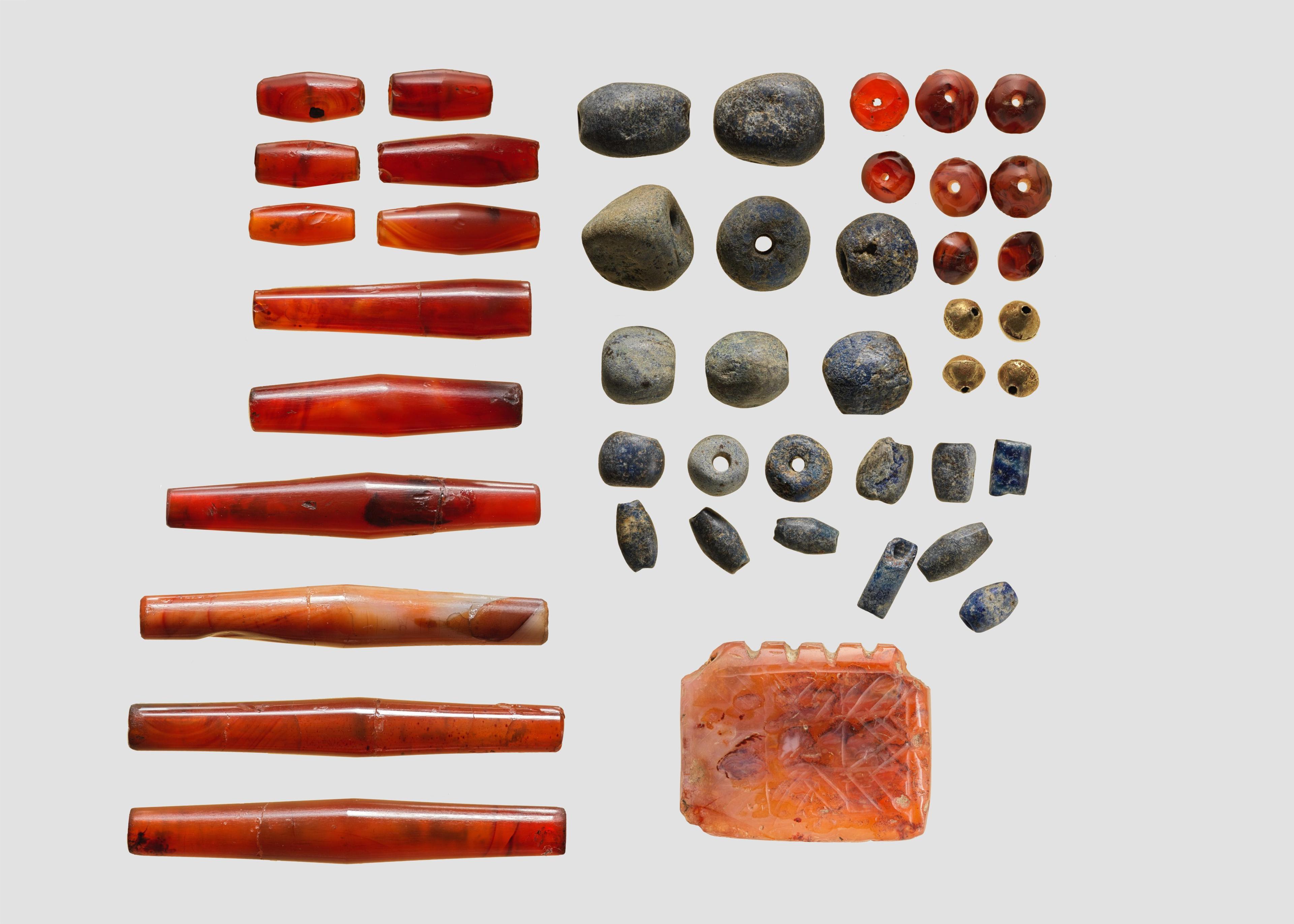
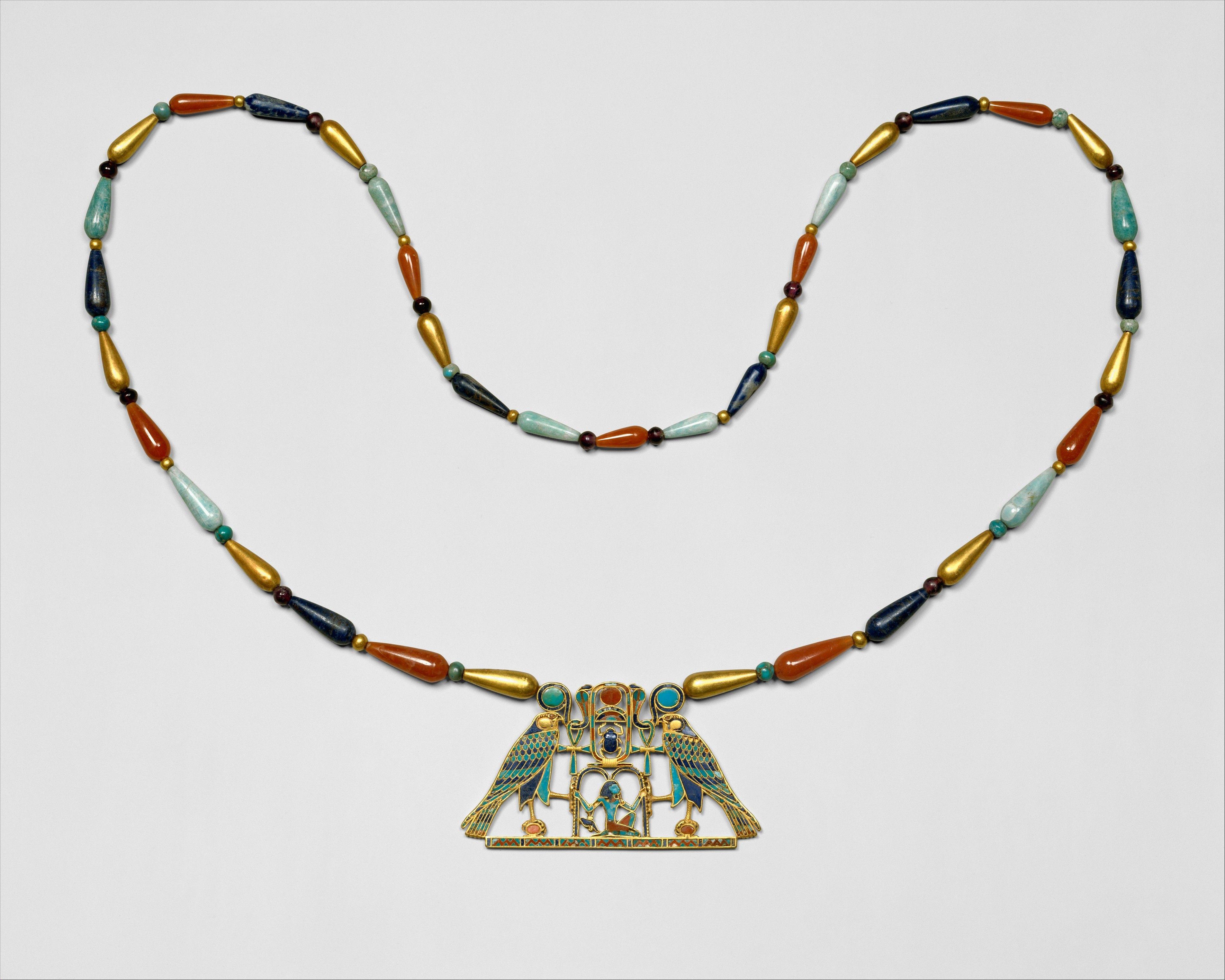
The combination of blue lapis, red carnelian and gold also appears in ancient Egyptian jewellery, as the pieces pictured here show. Lapis was worked into beads and inlays, allowing it to be used in both simple ornaments and elaborate royal pieces.
It was also included in Tutankhamun's gold burial mask. The Grand Egyptian Museum explains that the mask presents the king in the likeness of Osiris and the sun god Re, whose body was described as gold and whose hair was lapis lazuli. In this setting, the choice of material had a religious meaning as well as a decorative purpose.
4. Lapis was used to make ultramarine pigment
Lapis had another important use in painting, where it supplied the pigment known as natural ultramarine. Extracting the blue pigment from the stone took considerable work, and the finest grades could cost more than gold. That expense helps explain why it was often used sparingly or chosen for significant parts of a painting, including the Virgin Mary's robes.
Vermeer used it more generously. Research at the Mauritshuis found ultramarine in the blue headscarf of Girl with a Pearl Earring, but also mixed into the shadows of her yellow jacket. Its use was not confined to the areas that look blue at first glance.
Synthetic ultramarine was developed in the 1820s, giving painters a way to obtain the pigment without extracting it from lapis. The blue could now be manufactured, changing a market that had depended on the natural stone for centuries.
5. Jewellery value depends on design and condition
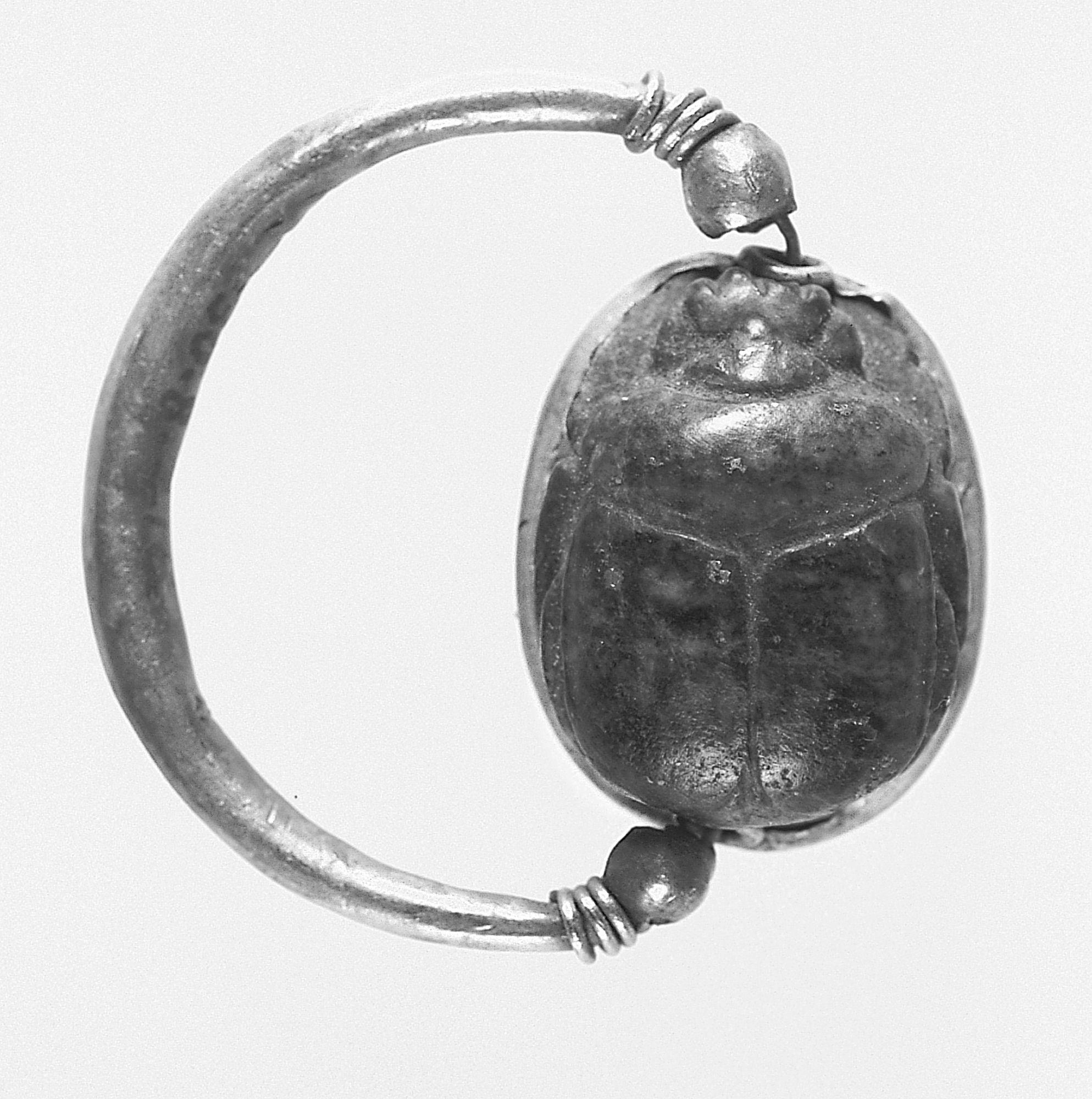
When looking at a lapis jewel, the quality of the stone is only part of what you are judging. The carving, setting, age and maker all contribute to its value. A well-made Art Deco ring, for example, can be worth much more than the lapis would be as a loose stone, because so much of its appeal lies in the finished design.
Condition deserves close attention too. Scratches and scuffing can dull the surface and make the blue look frosted. Repolishing may help, but older lapis pieces are sometimes drilled, pinned or enclosed in their settings, which can make removal difficult. A repair that looks simple at first may risk damaging both the stone and the jewellery.
Lapis can also be dyed, waxed or oiled to improve its appearance. GIA's care guidance notes that some treatments are vulnerable to heat or solvents, and recommends warm, soapy water for cleaning, testing a small, inconspicuous area first because some dyes are unstable. Avoid steam and ultrasonic cleaning.
Before buying, examine the colour in natural light and use a loupe to check the surface for wear. Ask about treatments and, if repairs are needed, find out what is possible before committing to the piece.
Why lapis still matters
The appeal of lapis starts with its colour, but there is plenty to choose between an even blue cabochon and a carved stone full of visible flecks. Its long history adds to the pleasure of owning it, while the quality of the work and the condition of the stone help distinguish a piece worth buying.
Listen to the episode
This article is based on Why Lapis Lazuli Was Once More Precious Than Gold.
Listen now →